Nashville’s climate makes material decisions on outdoor projects more consequential than they would be in drier parts of the country. Hot, humid summers, periodic hard freezes in winter, and heavy seasonal rain test outdoor structures in ways that affect how long materials last and how much maintenance they require. Choosing the right materials from the start is one of the best ways to avoid expensive repairs later.
And honestly, this is a conversation that comes up on every single project. You know, a lot of homeowners come in thinking material choice is a secondary decision. It is not. It is maybe the most important call you make before construction even starts.
That is why, as a reliable home remodeling team in Nashville, TN, BNG Remodel makes this topic a priority discussion before any build begins. Brittney Reader personally manages every outdoor project, and she leads the material conversation on every build.
Whether it is a straightforward deck in Smyrna, a covered porch addition in Brentwood, or a multi-level outdoor build in Germantown, making the right decision from the start saves homeowners significant time and money over the life of the structure.
Pressure-Treated Lumber: The Standard for a Reason
Pressure-treated lumber has been the backbone of residential decking in Nashville for decades, and it earns that position. The material is affordable and widely available, and when installed correctly with proper drainage spacing, appropriate fasteners, and adequate ventilation underneath, it holds up reliably through Tennessee’s climate.
A pressure-treated deck built on sound structural principles and maintained properly will last for many years on a Middle Tennessee property. The maintenance requirement deserves direct attention. Wood decking needs regular cleaning and resealing or restaining, typically every two to three years in Middle Tennessee’s humidity. Unmaintained boards start to gray, crack, and lift faster than they should.
For homeowners who are prepared to keep up with that cycle, pressure-treated lumber delivers strong value. For homeowners who prefer a lower-maintenance outdoor space, composite decking is the more practical choice.
Composite Decking: What It Does Well in Middle Tennessee
Composite decking has earned a significant share of the Nashville market, particularly among homeowners in Franklin, Brentwood, and Hendersonville planning long-term outdoor spaces. Benefits include:
- Resistance to moisture, UV exposure, and expansion and contraction that come with Middle Tennessee’s temperature swings
- Better appearance retention than wood over a 10 to 20-year ownership period
- Minimal upkeep, as periodic cleaning is typically all composite needs to stay in good condition year after year
The upfront cost is higher than pressure-treated lumber, sometimes considerably depending on the product line. The long-term tradeoff is real:
- Composite eliminates the maintenance cycle that wood requires
- It holds its color better through Nashville’s sun and humidity
Neither material is the right answer for every project or every homeowner. The right choice depends on:
- Budget
- Planned ownership timeline
- How much ongoing maintenance the homeowner is realistically prepared to take on
Structural Materials: Where Cutting Costs Has Consequences
The decking surface gets most of the attention. But the structural materials underneath? That is what actually keeps a deck standing over time.
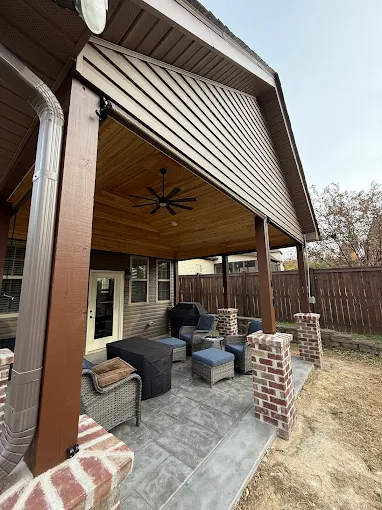
Posts, beams, joists, and the ledger board support everything, and when something goes wrong structurally, it usually starts there. For any raised or attached deck, proper framing with pressure-treated lumber and the right hardware is just not the place to cut corners.
Concrete footings need to be set below the frost line in Middle Tennessee. That is not a suggestion; it is a requirement, and it exists because freeze-thaw cycles in colder winters cause heaving if footings are too shallow.
Hardware matters here too, maybe more than people expect. Galvanized or stainless fasteners hold up well in Nashville’s humidity, while standard steel corrodes faster and can stain your decking over time.
Using the best degree framing nailer for the job is part of doing structural work correctly from the start. The angle and tool matter when you drive fasteners into pressure-treated lumber during framing. Our team treats these details as standard practice on every build, not as add-ons.
Railing Materials: Wood, Aluminum, and Cable Systems
The railing system is one of the most visible design elements on any deck, and material choice affects both appearance and maintenance over a long ownership period.
- Wood railings using pressure-treated or composite posts and balusters with a matching cap rail:
- Traditional look that suits older Middle Tennessee homes
- Can be painted or stained to coordinate with the home’s exterior
- Aluminum railing systems:
- Require virtually no maintenance
- Will not warp or rot
- Come in a range of colors and profiles that work across a variety of architectural styles
- Practical choice for homeowners who want a clean finished look without the upkeep that painted wood railings require
- Cable railing systems:
- Increasingly popular on Nashville decks raised off the ground
- Ideal where preserving sightlines into the yard is a priority
- Horizontal cable lines are visually minimal and do not block the view the way traditional balusters do
Covered Porch Roofing and Screening Materials
A covered porch introduces roofing materials into the project scope. The most common approach on Nashville covered porches is matching the existing roof material, typically asphalt shingles that coordinate with the home’s main roof, to create a cohesive look from the street.
Metal roofing panels are an option some homeowners prefer for their longevity and low-maintenance profile, especially when the roof pitch and style make metal a natural fit.
Screened-in porch enclosures use aluminum framing with either fiberglass or aluminum screen mesh. Fiberglass mesh is more common and less costly, while aluminum mesh resists tearing and denting better over time. The framing supporting a screened enclosure must meet full structural standards.
Screened porches built as lightweight add-ons with inadequate structure or undersized screen panels tend to fail within a few years in Middle Tennessee’s conditions. Building it right from the start is the only version worth constructing.
Related Topics: